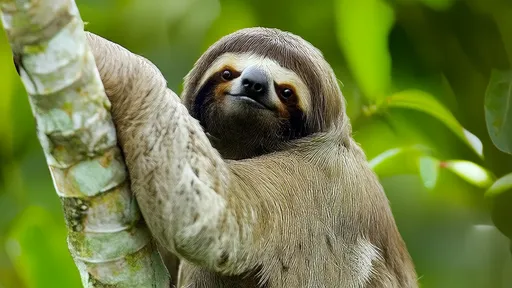
In the emerald canopies of Central and South American rainforests, one of nature's most deliberate dramas unfolds in ultra-slow motion. The sloth, an animal so synonymous with lethargy that its very name is a synonym for laziness, is not an evolutionary underachiever but a spectacularly adapted masterpiece of energy conservation. Its seemingly lackadaisical existence is, in fact, a profound and sophisticated survival strategy honed over millions of years, a testament to the fact that in the economy of nature, sometimes the best way to win is not to race, but to patiently outlast.
The sloth's entire physiology is a monument to minimalism. Its metabolic rate is one of the slowest of any mammal, operating at a pace that is a mere 40-45% of what would be expected for an animal of its size. This internal slowdown is the engine of its survival. It processes food with a languid patience, with a digestive process that can take up to a month to complete a single meal. This incredibly efficient system extracts the maximum possible nutrients from its low-energy diet of tough, fibrous leaves, a food source that is abundant but notoriously difficult to break down. By moving so slowly, both internally and externally, the sloth ensures that every single calorie consumed is stretched to its absolute limit, turning meager inputs into a sustainable, long-term energy budget.
This low-energy lifestyle dictates a unique relationship with the environment. The sloth's famously slow movement, averaging a mere 40 yards per day, is not a choice but a necessity. Each deliberate, hanging limb movement is calculated to expend the least amount of energy possible. This sedentary behavior serves a dual purpose. Firstly, it keeps its energy expenditure astonishingly low. Secondly, it makes the sloth incredibly difficult to detect. In a world teeming with sharp-eyed eagles and prowling jaguars, moving at a glacial pace and often remaining perfectly still allows the sloth to blend into the foliage, becoming virtually invisible. Its fur, a unique ecosystem in itself, hosts symbiotic algae that tint its coat a greenish hue, providing perfect camouflage against the green backdrop of the rainforest. This passive defense mechanism is far more energy-efficient than a life of constant flight and vigilance.
The sloth's survival is a delicate balancing act, a life lived on a metabolic knife-edge. This strategy, however, comes with significant trade-offs. The commitment to energy conservation is so absolute that it has relinquished abilities most mammals take for granted. It cannot shiver to generate warmth, making it highly susceptible to cold temperatures. It is a prisoner of the canopy, utterly helpless on the forest floor, its curved claws built for hanging, not for walking or defense. To venture down to the ground, a journey it risks only once a week for the perilous necessity of defecation, is to embark on the most dangerous endeavor of its life, exposing itself to terrestrial predators with virtually no means of escape. Its existence is a calculated gamble, betting everything on stillness and secrecy rather than speed or strength.
Perhaps the most fascinating aspect of the sloth's adaptation is the specialized ecosystem it cultivates on its own body. Its coarse, grooved fur is a hospitable environment for a multitude of organisms. Algae grow prolifically within the hair shafts, benefiting from the steady humidity and minimal disturbance. This relationship is mutually beneficial; the algae gain a home, and the sloth gains a greenish camouflage. Furthermore, a host of invertebrates, including moths and beetles, reside in this furry forest. Recent research suggests these moths may play a crucial role in the sloth's nutrient cycle, potentially ferrying nitrogen from the dung back to the fur to fertilize the algae, which the sloth may then consume through grooming, creating a closed-loop, energy-efficient recycling system literally on its own back.
In a modern world obsessed with speed, productivity, and relentless consumption, the sloth offers a silent, powerful counter-narrative. It is a living lesson in sustainability, demonstrating that thrift and efficiency can be a more viable long-term strategy than explosive power and rapid growth. Its evolutionary path is a brilliant alternative to the arms race of predation and defense; it simply opted out, finding a niche where it could thrive by demanding almost nothing from the world except the leaves within reach. The sloth does not fight its environment; it harmonizes with it so completely that it becomes a part of the scenery, a breathing, slow-moving leaf. Its success is measured not in territories conquered or prey captured, but in the sheer, enduring fact of its continued existence, a quiet triumph of patience over power.
Ultimately, the sloth's story is one of evolutionary genius. It is a powerful reminder that survival is not a one-size-fits-all formula. In the hyper-competitive natural world, where the fast and the strong often dominate the narrative, the sloth carved its own path to success through radical efficiency and impeccable timing. It challenges our deepest biases about what it means to be a successful animal. Its languid pace is not a failure but the very key to its resilience, a brilliant adaptation that has allowed it to inhabit its ecological niche for tens of millions of years. The sloth teaches us that sometimes, the ultimate wisdom lies not in a frantic struggle for more, but in the profound art of needing less.
By /Aug 21, 2025

By /Aug 21, 2025
By /Aug 21, 2025

By /Aug 21, 2025

By /Aug 21, 2025
By /Aug 21, 2025

By /Aug 21, 2025
By /Aug 21, 2025
By /Aug 21, 2025
By /Aug 21, 2025
By /Aug 21, 2025
By /Aug 21, 2025

By /Aug 21, 2025
By /Aug 21, 2025

By /Aug 21, 2025

By /Aug 21, 2025
By /Aug 21, 2025
By /Aug 21, 2025
By /Aug 21, 2025
By /Aug 21, 2025
