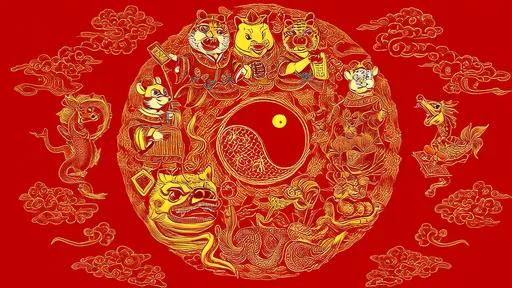
The origins of the Chinese zodiac, known as Shengxiao, weave through millennia of cultural evolution, philosophical inquiry, and folk imagination. Unlike Western astrology's focus on celestial patterns, this system roots itself deeply in earthly cycles, animal symbolism, and a profound connection to the rhythms of agrarian life. Its twelve animal signs—Rat, Ox, Tiger, Rabbit, Dragon, Snake, Horse, Goat, Monkey, Rooster, Dog, and Pig—form more than a simple calendar; they are a complex symbolic language that has shaped Chinese thought, art, and social customs for centuries.
One of the most enduring legends explaining the zodiac's order comes from a mythical race orchestrated by the Jade Emperor, a supreme deity in Taoist mythology. The story tells that the emperor decreed the order of the years would be determined by the sequence in which twelve animals arrived at his palace. The clever Rat, hitched a ride on the diligent Ox's back, leaping off at the last moment to claim first place. The powerful Tiger and agile Rabbit followed, while the majestic Dragon, delayed by an act of compassion, came fifth. The Horse and Snake, entangled in a trick, arrived next, followed by the cooperative Goat, Monkey, and Rooster. The loyal Dog, distracted by play, and the leisurely Pig brought up the rear. This charming narrative, passed down through generations, is not merely a children's fable but a rich allegory embedding values of cunning, diligence, power, compassion, cooperation, and loyalty directly into the cultural consciousness.
Archaeological and historical evidence suggests the zodiac's conceptual framework began to crystallize during the Han Dynasty (206 BCE – 220 CE), a period of immense cultural consolidation and philosophical development. Its foundation is the ancient sexagenary cycle, a complex method of tracking time using ten Heavenly Stems and twelve Earthly Branches. It was the pairing of the twelve Earthly Branches with specific animals that gave birth to the zodiac as it is known today. This system provided a practical, cyclical way to mark not only years but also months, days, and hours, integrating cosmic and earthly realms. The assignment of animals was likely influenced by older totemic beliefs, ancient worship of animal deities, and observations of animal activity throughout the day and year, creating a seamless fusion of astronomy, timekeeping, and natural philosophy.
Each animal in the zodiac carries a dense portfolio of attributes, creating a multifaceted symbolic system. The Rat, often viewed negatively in the West, is emblematic of wit, adaptability, and prosperity. The Ox represents unwavering strength, diligence, and reliability. The Tiger is the bold warrior, symbolizing courage, power, and unpredictability. The Rabbit embodies grace, caution, and longevity. The Dragon, the only mythical creature, is the ultimate symbol of potent authority, success, and good fortune. The Snake denotes wisdom, intuition, and a connection to the mystical. The Horse signifies energy, freedom, and perseverance. The Goat (or Sheep) reflects artistry, peace, and kindness. The Monkey is the clever trickster, representing intelligence and innovation. The Rooster symbolizes confidence, punctuality, and fidelity. The Dog stands for loyalty, honesty, and a strong sense of justice. Finally, the Pig represents generosity, diligence, and prosperity. These are not static definitions but a spectrum of meanings that interact and contrast with one another, offering a nuanced tool for understanding human character and destiny.
The zodiac's influence permeates the very fabric of Chinese society, far beyond knowing one's birth year. It is a cornerstone of traditional astrology, used for centuries in matchmaking to assess the compatibility of potential spouses. A pairing like the Dog and Rabbit is considered highly harmonious, promoting mutual understanding, while other combinations might require careful navigation. The system dictates auspicious dates for life's most important events—weddings, business openings, moving house—ensuring actions are in harmony with the cosmic flow. In art and literature, zodiac motifs are ubiquitous, from ancient bronze vessels and imperial robes to New Year's prints and modern cinematic narratives, serving as a visual and thematic shorthand for complex human traits and cosmic forces.
As Chinese culture has spread across the globe, the zodiac has become one of its most recognizable and embraced exports. Lunar New Year celebrations in major cities worldwide are now synonymous with the animal of the year, from dragon dances to giant rat sculptures. This global fascination, however, often simplifies the system into a form of entertainment or a generalized Asian horoscope, sometimes stripping it of its deep cultural and philosophical context. The challenge in the modern era lies in appreciating the zodiac as both a fun, accessible cultural icon and a profound, ancient worldview that offers a unique perspective on time, nature, and human nature itself.
Ultimately, the Chinese zodiac is a living tradition. It is a bridge connecting the ancient past to the dynamic present, a symbolic language that continues to evolve. It provides a framework for millions to understand their place in the universe, their relationships with others, and the cyclical nature of life itself. It is not a rigid set of beliefs but a fluid, cultural narrative—a testament to humanity's enduring desire to find pattern, meaning, and a little magic in the passage of time.

By /Aug 21, 2025

By /Aug 21, 2025

By /Aug 21, 2025
By /Aug 21, 2025
By /Aug 21, 2025

By /Aug 21, 2025

By /Aug 21, 2025
By /Aug 21, 2025

By /Aug 21, 2025
By /Aug 21, 2025
By /Aug 21, 2025

By /Aug 21, 2025
By /Aug 21, 2025
By /Aug 21, 2025

By /Aug 21, 2025
By /Aug 21, 2025

By /Aug 21, 2025
By /Aug 21, 2025
By /Aug 21, 2025
By /Aug 21, 2025
