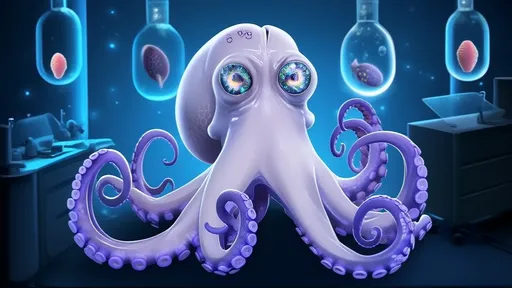
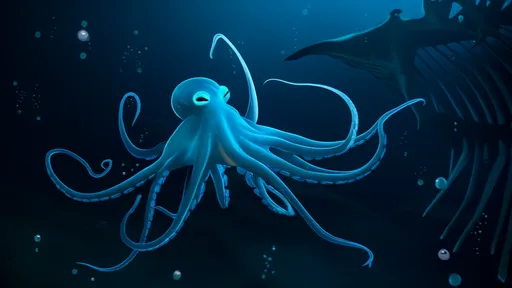
The ocean depths hold mysteries that have long captivated scientists and laypeople alike, but few are as enigmatic as the intelligence of the cephalopod. Among these soft-bodied marvels, the octopus stands out not merely for its ability to change color and shape with breathtaking speed, but for a cognitive prowess that seems utterly alien. This is an intelligence born not from a centralized brain housed in a bony skull, like our own, but from a radically different biological blueprint: a distributed nervous system that challenges our very definitions of thought, consciousness, and mind.
At the heart of this puzzle is the octopus's unique neuroanatomy. For every vertebrate, from the simplest fish to the most complex primate, intelligence is a top-down affair. A large, centralized brain acts as the command center, processing sensory input, formulating decisions, and sending commands down the spinal cord to the body's periphery. The octopus, an invertebrate mollusk, has utterly discarded this model. Its nervous system is a decentralized network, a democracy of neurons where the body itself seems to possess a mind of its own. Of the creature's roughly 500 million neurons—a number comparable to a dog—a surprising two-thirds are not located in its central brain but are distributed throughout its eight arms.
This arrangement grants each arm a startling degree of autonomy. An amputated octopus arm will continue to crawl, grasp, and even execute simple tasks for a considerable time after separation. Experiments have shown that arms can solve puzzles—like unscrewing a jar lid to reach food—even when sensory information from the arm is prevented from reaching the brain, and motor commands from the brain are blocked from reaching the arm. This suggests a form of localized intelligence, where complex sensory and motor processing occurs on-site. The central brain might not micromanage every suction cup's movement but may instead issue a high-level command, such as "grab that crab," leaving the intricate execution to the neural circuitry woven into the arm itself.
This raises a profound philosophical and biological question: where does cognition reside? For us, it is self-evidently in the head. For the octopus, the answer is far more nebulous. Is its consciousness a unified experience emerging from its central brain, or is it a fragmented, distributed phenomenon, a chorus of semi-independent actors? The octopus's central brain, donut-shaped and surrounding its esophagus, is undoubtedly sophisticated. It is responsible for learning, memory, and complex behaviors like navigation and tool use. Yet, it must also integrate a constant flood of information from its eight independently exploring limbs, each with its own "opinion" about what it is touching and tasting.
The sensory capabilities of the arms are a key to understanding this system. An octopus's suckers are not mere mechanical tools; they are packed with chemoreceptors, allowing the animal to "taste" everything it touches. Each sucker can independently identify textures and chemicals, sending a rich stream of data to the local nerve cord in the arm for preliminary processing before a distilled version is sent upward to the central brain. This allows for an incredibly efficient division of labor. The arms can handle the grunt work of exploration and manipulation, freeing the central brain to focus on higher-order tasks like planning, threat assessment, and long-term memory.
This evolutionary path is a spectacular example of convergence. Vertebrates and cephalopods last shared a common ancestor over 600 million years ago, a simple, likely worm-like creature with a rudimentary nervous system. From that point, the two lineages embarked on completely separate journeys toward complexity. Vertebrates armored their central nerve cord in bone, leading to the development of large, protected brains. Cephalopods, abandoning their shells for agility and camouflage, found a different solution. They embedded intelligence directly into their flexible, boneless bodies. They evolved a nervous system that is not a single master computer but a vast, interactive network—a body-wide web of processing power.
The implications of this distributed intelligence are visible in the octopus's astonishing behavioral repertoire. Their problem-solving skills are legendary. They can navigate complex mazes, open child-proof jars, and even escape from seemingly secure aquariums. Their play behavior—a strong indicator of advanced cognition—has been documented, with individuals repeatedly pushing bottles into a circular current in their tank for what appears to be sheer amusement. Their mastery of camouflage is not a simple reflex but a dynamic, active decision-making process. They can assess a background's visual texture, color, and even depth in milliseconds and command millions of chromatophores in their skin to recreate it, often while simultaneously sculpting their body shape to match nearby rocks or coral.
Yet, for all its brilliance, this intelligence may come at a cost. The octopus's lifespan is tragically short, most species living only one to two years. They are largely asocial and do not teach their young, who are left to fend for themselves from the moment they hatch. This suggests their remarkable abilities are not culturally transmitted but are instead hardwired—the product of a uniquely powerful and self-sufficient neural architecture. It is an intelligence that is learned anew by each individual, a testament to an immense capacity for solo exploration and experimentation.
Studying the octopus nervous system does more than satisfy our curiosity about a fascinating animal. It fundamentally expands our understanding of what intelligence can be. It demonstrates that a large, centralized brain is not the only path to complex cognition. Mind can be embodied; thought can be distributed. The octopus, a soft-bodied denizen of the deep, offers a powerful alternative model of being. Its tangled ganglia and autonomous arms present a profound mystery: the possibility of another kind of consciousness, one that is woven into the very fabric of a living body, a reminder that in the vast theater of evolution, the mind has taken the stage in many strange and wonderful forms.

By /Aug 21, 2025
By /Aug 21, 2025

By /Aug 21, 2025
By /Aug 21, 2025
By /Aug 21, 2025
By /Aug 21, 2025
By /Aug 21, 2025

By /Aug 21, 2025
By /Aug 21, 2025
By /Aug 21, 2025

By /Aug 21, 2025
By /Aug 21, 2025

By /Aug 21, 2025

By /Aug 21, 2025

By /Aug 21, 2025
By /Aug 21, 2025
By /Aug 21, 2025

By /Aug 21, 2025
By /Aug 21, 2025
By /Aug 21, 2025
