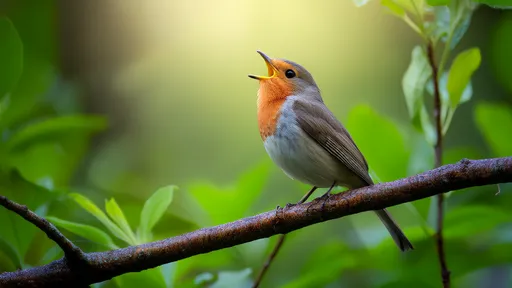
In the quiet hours of dawn, when the world still slumbers beneath a veil of mist, nature’s most intricate symphony begins to unfold. It is not performed by human hands or composed in grand concert halls, but by feathered musicians perched among the branches—the birds. Their songs, far from mere random chirps, represent one of the most sophisticated forms of acoustic communication in the animal kingdom. For centuries, poets and naturalists have marveled at these melodies, but only in recent decades has science begun to unravel the profound complexity and purpose behind avian vocalizations.
Birdsong is not a monolithic phenomenon; it varies dramatically across species, environments, and even individuals. Some birds, like the nightingale, are celebrated for their rich, melodious repertoires, capable of producing hundreds of distinct phrases. Others, such as the common crow, rely on simpler calls but use them with remarkable contextual intelligence. What unites them all is the biological and evolutionary sophistication underlying their sounds. Research has revealed that birdsong involves intricate neural pathways, precise motor control, and in many cases, a form of learning akin to human language acquisition.
At the heart of this vocal prowess lies the syrinx, a unique organ located at the base of a bird’s trachea. Unlike the human larynx, which produces sound through a single set of vocal folds, the syrinx is often doubly structured, allowing some birds to generate two independent sounds simultaneously. This biological marvel enables species like the wood thrush to create haunting, flute-like harmonies that seem to emanate from multiple sources. The control exerted over this organ is equally impressive; minute adjustments in muscle tension and airflow can produce an astonishing range of frequencies, tones, and amplitudes.
But the physical ability to produce sound is only part of the story. The true genius of birdsong lies in its function and complexity. For many species, singing is primarily a tool for territorial defense and mate attraction. A robust, elaborate song signals to potential rivals that a territory is occupied and to prospective mates that the singer is healthy, experienced, and genetically superior. Studies on species like the zebra finch have shown that females often prefer males with larger or more complex song repertoires, linking vocal performance directly to reproductive success.
Beyond courtship and territory, birdsong serves as a critical medium for social cohesion and individual recognition. Flocking birds, such as sparrows or starlings, use specific calls to maintain contact, coordinate movements, or alert others to danger. Some species even possess signature songs or calls that act as acoustic fingerprints, allowing individuals to identify each other within a dense chorus of voices. This level of vocal individuality hints at a social complexity that parallels aspects of human society.
Perhaps the most fascinating aspect of birdsong is its learned nature. While some birds are born with innate calls, many songbirds must learn their melodies through a process strikingly similar to how human infants learn to speak. Young birds listen to and memorize the songs of adult tutors, often their fathers or neighboring males. They then practice tirelessly, refining their vocalizations through auditory feedback until they achieve a perfect match. This cultural transmission means that regional dialects can develop, with populations in different areas singing distinct variations of the same species-specific tune.
Neuroscientists have devoted considerable attention to the avian brain, uncovering specialized structures dedicated to song production and learning. The song system, a network of interconnected nuclei, governs everything from song perception to motor execution. In species like canaries, which change their songs seasonally, these brain regions even exhibit plasticity, growing and shrinking in response to hormonal changes and learning demands. This neural adaptability provides a powerful model for understanding how brains, including our own, encode and produce complex learned behaviors.
The study of birdsong has also ventured into the realm of music theory. Some researchers argue that certain species employ musical principles such as rhythm, phrasing, and even thematic development in their songs. The hermit thrush, for example, sings in pitches that align with the harmonic series—a fundamental concept in Western music. While it is debated whether this constitutes true musicality, it undeniably blurs the line between animal communication and artistic expression, challenging our definitions of music itself.
However, this ancient acoustic art faces modern threats. Urban noise pollution, habitat destruction, and climate change are disrupting the soundscapes upon which birds depend. Studies show that birds in noisy environments often sing at higher pitches or during quieter times to be heard, which can affect their mating and foraging success. The loss of acoustic niches may lead to cultural erosion, where learned songs are simplified or lost altogether. Conservation efforts are now increasingly considering not just the physical but also the sonic environment, recognizing that a silent forest is an impoverished one.
Technological advances are opening new frontiers in birdsong research. High-resolution audio recording devices and machine learning algorithms can now analyze vast datasets of vocalizations, identifying patterns and variations imperceptible to the human ear. These tools are helping scientists decode the syntax of birdsong, map its diversity across continents, and monitor population health through acoustic biomarkers. Each discovery peels back another layer, revealing the depth of intelligence and creativity embedded in these aerial melodies.
In the end, birdsong is more than a biological curiosity; it is a window into the evolution of communication, the origins of learning, and the universal principles that might underlie all complex vocal systems, including human language. It reminds us that long before we composed symphonies or wrote poetry, the natural world was already rich with music—crafted by evolution, perfected by practice, and performed daily by masters whose stage is the open sky. To listen closely is to hear not just beauty, but a profound dialogue between life and its environment, written in notes that have echoed through millions of years.

By /Aug 21, 2025

By /Aug 21, 2025

By /Aug 21, 2025

By /Aug 21, 2025

By /Aug 21, 2025

By /Aug 21, 2025

By /Aug 21, 2025
By /Aug 21, 2025
By /Aug 21, 2025
By /Aug 21, 2025

By /Aug 21, 2025

By /Aug 21, 2025

By /Aug 21, 2025
By /Aug 21, 2025

By /Aug 21, 2025

By /Aug 21, 2025

By /Aug 21, 2025
By /Aug 21, 2025

By /Aug 21, 2025

By /Aug 21, 2025
