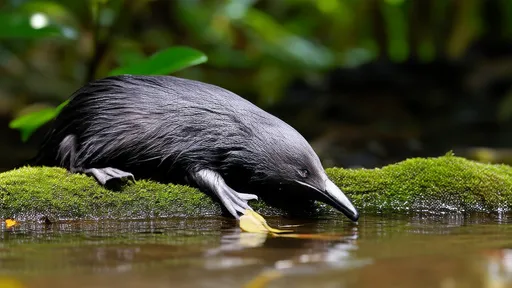
In the realm of biological curiosities, few creatures capture the imagination quite like the platypus. This enigmatic Australian native, with its duck-like bill, beaver-like tail, and otter-like feet, has long baffled naturalists and scientists alike. When the first platypus specimen reached Europe in the late 18th century, many believed it to be an elaborate hoax, a stitched-together monstrosity. Yet, this peculiar animal is very real, and its existence offers a profound window into the complex tapestry of mammalian evolution, representing a branch that diverged onto a wildly different path over 160 million years ago.
The initial confusion surrounding the platypus is understandable. It possesses a suite of characteristics that seem to defy simple classification. As a mammal, it is warm-blooded, has fur, and produces milk to feed its young. However, it also lays leathery eggs, a trait almost universally associated with reptiles and birds. This combination of features immediately positioned the platypus, and its cousin the echidna, into their own distinct order: the monotremes. They are the only living representatives of this ancient lineage, a precious relic from a time when the evolutionary pathways of modern mammals were just beginning to fork.
Delving deeper into its physiology only reveals more paradoxes. The platypus bill is not a rigid structure like a bird's beak; it is a soft, leathery, and highly sensitive organ packed with electroreceptors. These allow the platypus to detect the minute electrical fields generated by the muscle contractions of its prey—shrimp, insects, and worms—as it forages along riverbeds with its eyes, ears, and nostrils tightly shut. This form of electrolocation is a remarkable sensory adaptation more commonly found in sharks and rays, making its presence in a mammal truly extraordinary.
Perhaps one of its most astonishing armaments is something straight out of a fantasy novel: venom. Male platypuses possess a sharp, hollow spur on each of their hind ankles, connected to a venom gland in the thigh. This venom, a complex cocktail of proteins, is not used for hunting but is deployed during fierce battles with rival males during the breeding season. While not lethal to humans, a spurring results in immediate, excruciating pain and swelling that can last for weeks and is resistant to conventional painkillers. The presence of such a sophisticated venom delivery system is a trait almost unheard of in other mammals, further highlighting its evolutionary uniqueness.
The reproductive strategy of the platypus is a masterclass in evolutionary conservatism. Unlike the vast majority of mammals that give birth to live young, the female platypus retires to a long, elaborate burrow to lay one to three small eggs. She incubates them by curling her body around them for about ten days. Once the tiny, vulnerable young hatch, the story shifts to one of quintessential mammalian care. The mother lactates, but true to monotreme form, she does so in a peculiar way. She has no teats. Instead, milk is secreted through pores that blanket her abdomen, and the young pups lap it up from the skin and fur. This method of milk delivery is believed to be the original, primitive state for all mammals.
Unlocking the secrets of the platypus required peering into its very blueprint: its genome. When its DNA was first sequenced, scientists discovered a breathtaking genetic mosaic. The platypus genome contains roughly the same number of protein-coding genes as other mammals, but the mix is startling. It holds genes for milk production alongside genes for egg-laying. It carries genes for venom production that are reminiscent of those found in reptiles. Its sex determination system is equally bizarre; while most mammals use XX/XY chromosomes, the platypus has ten sex chromosomes that form a complex chain during meiosis, a system more akin to that of birds. This genetic patchwork is a direct reflection of its evolutionary position, straddling the divide between reptiles and mammals.
The story of the platypus is not merely one of oddities for their own sake. It is a critical piece of evidence in the puzzle of how mammals came to be. Monotremes like the platypus are thought to have split from the lineage that would lead to marsupials and placental mammals (like humans) during the Jurassic period. They represent an early, and largely unchanged, experiment in mammalian evolution. By studying them, we are essentially looking back in time, observing the foundational traits from which all other mammalian life diversified. They show us that the earliest mammals were likely small, shrew-like creatures that laid eggs and possessed a blend of reptilian and advanced mammalian characteristics.
Today, the platypus faces modern challenges. Habitat destruction, pollution, climate change-induced drought, and historical fur hunting have placed pressure on its populations. Recognizing its immense scientific and natural value, conservation efforts are underway to protect the river systems it calls home. Its status as a unique evolutionary treasure makes its preservation not just an environmental concern, but a scientific imperative. Losing the platypus would be like losing a key chapter from the grand book of life on Earth.
In conclusion, the platypus is far more than a biological oddity or a tourist attraction. It is a living fossil, a testament to the unpredictable and wondrous nature of evolution. Its duck bill, venomous spur, electroreception, and egg-laying habits are not mere quirks but are profound clues to a deep evolutionary past. It challenges our rigid definitions and reminds us that nature's rulebook is fluid and creative. The platypus, in all its glorious weirdness, is a singular beacon on the mammalian family tree, illuminating a path not taken by the rest of us, and in doing so, it helps to explain the very essence of what we are.
By /Aug 21, 2025
By /Aug 21, 2025
By /Aug 21, 2025
By /Aug 21, 2025
By /Aug 21, 2025
By /Aug 21, 2025

By /Aug 21, 2025
By /Aug 21, 2025
By /Aug 21, 2025
By /Aug 21, 2025
By /Aug 21, 2025
By /Aug 21, 2025

By /Aug 21, 2025
By /Aug 21, 2025

By /Aug 21, 2025
By /Aug 21, 2025
By /Aug 21, 2025
By /Aug 21, 2025
By /Aug 21, 2025
By /Aug 21, 2025
