Nestled in the misty mountains of Jiangxi province, Jingdezhen has been the undisputed ceramic capital of China for over a millennium. For centuries, its kilns have produced porcelain so exquisite it was known simply as "white gold" in imperial courts across continents. Today, this city offers more than just historical reverence; it opens its workshops to those seeking not merely to observe, but to create. A short-term pottery course here is not a tourist activity—it is a profound dialogue with history, material, and self.
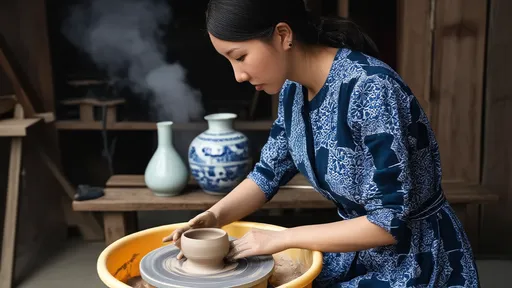
The journey into clay begins at the potter's wheel, a device whose basic principle has changed little in centuries. Under the guidance of masters whose hands have shaped countless pieces, students learn the first sacred rule: centering. This is where many discover that clay has a will of its own. The wheel spins, a whirlpool of earthy potential, and the potter's wet hands must apply equal pressure, finding a delicate balance between force and surrender. It is a humbling, often frustrating, initiation. Fingers that type on keyboards and swipe on screens must now relearn a primal language of touch. A wobble emerges, the form collapses, and a lump of clay is returned to the wedge board to be kneaded and begun anew. This repetition is the first lesson in patience and presence.
Success, when it comes, is a quiet miracle. The centered clay rises, a cool, smooth cylinder under your palms. A thumb pressed into its peak opens a cavity. Gentle pressure from within and without coaxes the walls upward and outward, the form emerging like a slow breath. This is the birth of a bowl, a vase, a cup. It is in this meditative state that time distorts. The outside world fades, replaced by the whir of the wheel, the scent of wet earth, and the focused intention of creating something from nothing. The master potter might nod, a silent approval, before demonstrating how to lift the form from the wheel with a taut wire, a final, delicate surgery.
But a piece fresh from the wheel is only a beginning, a newborn. It must now undergo the first transformation: drying to a state known as "leather hard." In this interim period, the clay is firm yet still malleable enough to be carved, trimmed, and handled without losing its shape. This is where personality is etched into the piece. Students learn to use fine loops and wires to shave away excess clay from the base, creating a foot ring—a signature of hand-thrown work. This is also the stage for adding handles, spouts, or intricate sgraffito designs, scratching through a thin layer of slip to reveal the contrasting clay body beneath. Each decision, each carved line, imprints the maker's unique signature.
Once bone dry, the fragile "greenware" is ready for its first trial by fire: the bisque firing. Loaded carefully into an electric or, for the truly fortunate, a traditional wood-fired kiln, the pieces are heated to around 900°C. This initial firing drives out all remaining physical water and chemically bonded water from the clay particles, transforming the soft clay into a hard, porous, and stable ceramic material. It is no longer mud; it can now never return to the earth from which it came. This alchemical process is mostly silent and unseen, a test of faith for the new potter who must entrust their creations to the flames.
Emerging from the bisque kiln, the pieces are ready to meet color. Glazing is arguably the most magical and unpredictable phase of ceramics. The bisqueware, now thirsty and absorbent, is dipped, poured over, or painted with a slurry of minerals suspended in water—the glaze. In its liquid state, the glaze often shows little hint of its final color. A dull gray dip might yield a brilliant celadon green; a creamy white brushstroke might transform into a deep, bloody oxblood red. The application is a lesson in chemistry and courage. Too thin, and the finish will be weak and uneven; too thick, and it will run off the piece during the high-fire, fusing it permanently to the kiln shelf.
The final and most dramatic metamorphosis occurs in the high-temperature glaze firing. The kiln is heated to its peak, often between 1280°C and 1350°C, a searing heat that liquefies the applied glaze powders into a hard, glassy coating. The silica in the glaze melts and fuses with the clay body, creating an impervious, vitrified surface. Inside the kiln, molecular structures break down and reform; colors bloom and flow in the intense heat. For a wood-fired kiln, the ash from the burning wood settles on the pieces, creating natural, unpredictable ash glazes that are highly prized. The process can take over a day, the kiln master patiently stoking and monitoring the temperature climb along a sacred curve.
Then, the wait. The kiln must cool for another day, sometimes two, before it can be opened. The unloading ceremony is a moment of collective anticipation and anxiety. As the kiln door is cracked, a wave of residual warmth pours out. One by one, the shelves are unloaded. There are gasps of delight and sighs of disappointment. The results are never guaranteed. A piece that seemed perfect before may have cracked; a glaze experiment may have produced a breathtaking, one-of-a-kind effect far beyond expectations. This embrace of the unexpected, of ceding ultimate control to the elemental forces of fire and chemistry, is the final and most profound lesson of Jingdezhen.
To walk out of a short-term course in Jingdezhen with your own fired pieces is to carry more than just souvenirs. You carry the memory of the wheel's spin, the concentration in the silent workshop, the camaraderie with fellow creators, and the awe of the kiln's power. You carry an understanding that every bowl, every cup you ever use, is the culmination of a long, vulnerable, and miraculous process. It is a connection to an ancient lineage of makers, a brief but deep immersion into the soul of a city built on clay and fire, and a reminder that from the earth, through our hands, beauty is born.

By /Aug 22, 2025

By /Aug 22, 2025

By /Aug 22, 2025

By /Aug 22, 2025
By /Aug 22, 2025

By /Aug 22, 2025

By /Aug 22, 2025

By /Aug 22, 2025

By /Aug 22, 2025

By /Aug 22, 2025

By /Aug 22, 2025
By /Aug 22, 2025

By /Aug 22, 2025
By /Aug 22, 2025

By /Aug 22, 2025

By /Aug 22, 2025

By /Aug 22, 2025

By /Aug 22, 2025
By /Aug 22, 2025

By /Aug 22, 2025
