In the heart of Suzhou, where classical Chinese garden design reaches its zenith, two masterpieces stand as timeless testaments to the art of landscape architecture: the Humble Administrator’s Garden and the Lingering Garden. Both are UNESCO World Heritage Sites, both are celebrated as paragons of the Ming and Qing dynasty gardening traditions, and to the untrained eye, they might even appear similar. Yet, to truly appreciate them is to understand that they represent two distinct, profound, and equally brilliant philosophies of design. Their beauty lies not just in their shared elements—the meandering waterways, the poetic pavilions, the cleverly framed views—but in the unique spirit and aesthetic intention that animates each space.
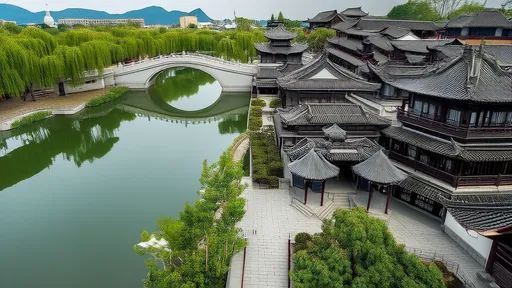
The Humble Administrator’s Garden, the largest of Suzhou’s classical gardens, feels like a world unto itself. Its design philosophy is one of expansive, watery grandeur. Conceived during the Ming Dynasty, it embodies a scholar-official’s idealized retreat, a microcosm of the natural world where water is the dominant, life-giving element. Upon entering, the visitor is not greeted by a series of enclosed courtyards but is instead drawn into a vast, open landscape where pavilions and halls are arranged around a central, sprawling lake. This extensive use of water creates a feeling of openness and tranquility, a sense of being in a rustic, watery paradise far removed from the bustling city outside its walls.
This central lake is the garden’s lungs and its heart. It is not a single, static pool but a complex, interconnected network of waterways, ponds, and islands. The design encourages a journey, both physical and contemplative. One follows paths that skirt the water’s edge, crosses elegant bridges that connect verdant islets, and pauses in pavilions whose very names—like the "Pavilion of the Fragrant Snow and Azure Clouds"—evoke the poetic experience of the place. The vistas are broad and painterly, designed to be viewed from a distance, much like a monumental landscape scroll painting unrolling before one’s eyes. The garden’s beauty is in its scale and its harmonious, naturalistic composition, making man feel a part of a larger, majestic nature.
In stark contrast, the Lingering Garden, a pinnacle of Qing Dynasty garden design, operates on an entirely different principle. If the Humble Administrator’s Garden is a grand epic poem, the Lingering Garden is an intricate sonnet. Its genius lies not in expansive views but in a sophisticated sequence of compressed, intensely composed spaces that unfold gradually, revealing themselves one after another. The element of surprise is central to its design. The garden is a masterpiece of spatial manipulation, using a winding path to guide the visitor through a carefully choreographed experience of contrast: tight, narrow corridors suddenly open into bright, spacious courtyards; a small, dark entryway gives way to a stunning vista of a rockery or a pavilion.
This journey is one of discovery and intellectual delight. The garden is famously divided into four distinct sections: artificial hills, pastoral landscapes, forested groves, and immaculate courtyards. The transitions between these sections are not abrupt but are masterfully managed through the art of "borrowed scenery" (jie jing) and "framed scenery" (kuang jing). Windows in whitewashed walls are not merely openings but are treated as living picture frames, offering tantalizing glimpses of the beauty that lies in the next section, building anticipation and wonder. The famous "Cloud-Capped Peak," a massive, grotesquely beautiful limestone rockery, is the garden’s centerpiece, but it is never fully revealed at once. It is viewed from different angles and through different frames, each perspective offering a new interpretation of its form.
The treatment of rockeries further highlights the aesthetic divergence. In the Humble Administrator’s Garden, rocks are used as complementary elements. They shore up banks, form grottoes, and create small islands, but they are subservient to the dominant water element. They feel like natural outcroppings in a lakeside landscape. In the Lingering Garden, rocks are the protagonists. The "Cloud-Capped Peak" and its surrounding rock formations are the stars of the show. These are not simple stones; they are meticulously selected Taihu rocks, prized for their perforated, wrinkled, and sculptural qualities. They are art objects in their own right, placed on pedestals for contemplation, representing the abstract essence of mountains and the dynamic forces of nature. Their placement is calculated for maximum dramatic effect within the garden’s intricate spatial sequence.
This difference in spatial experience extends to the buildings within each garden. The structures in the Humble Administrator’s Garden are positioned to maximize the enjoyment of the vast aquatic scenery. Pavilions like the "Faraway Looking Pavilion" are placed at strategic points to command sweeping views of the water and the distant borrowed scenery of the North Temple Pagoda. The architecture serves the landscape. In the Lingering Garden, the buildings are integral to creating the sequence of spaces themselves. Corridors twist and turn, not just as sheltered walkways but as devices to control the line of sight. A hall might be placed to block a view completely, only for a perfectly framed window on its side wall to offer a mysterious and beautiful hint of what is to come. Here, the architecture and the landscape are fused in a more intellectual and theatrical partnership.
Ultimately, the two gardens appeal to different facets of the human spirit. The Humble Administrator’s Garden offers a sense of liberation and harmony with a grand, idealized nature. It is a place for melancholy reflection, for losing oneself in the beauty of water, lotus flowers, and distant views. It is cosmic and philosophical. The Lingering Garden, by contrast, is a feat of human ingenuity and artistic compression. It is a place of intellectual engagement, of surprise and delight, where every turn presents a new, perfectly composed picture. It celebrates the art of illusion and the joy of discovery within a limited space.
To walk through both is to understand the incredible breadth of Chinese garden aesthetics. One is not superior to the other; they are complementary masterpieces. The Humble Administrator’s Garden is the expansive, watery dream of a Ming scholar seeking solace in nature’s grandeur. The Lingering Garden is the intricate, intellectual puzzle of a Qing connoisseur showcasing the utmost refinement in design. Together, they form the yin and yang of Suzhou’s garden tradition, one open and fluid, the other intimate and structured, both offering an endless source of aesthetic contemplation and profound peace.

By /Aug 22, 2025

By /Aug 22, 2025

By /Aug 22, 2025

By /Aug 22, 2025
By /Aug 22, 2025

By /Aug 22, 2025
By /Aug 22, 2025

By /Aug 22, 2025

By /Aug 22, 2025
By /Aug 22, 2025
By /Aug 22, 2025
By /Aug 22, 2025

By /Aug 22, 2025
By /Aug 22, 2025

By /Aug 22, 2025

By /Aug 22, 2025

By /Aug 22, 2025

By /Aug 22, 2025

By /Aug 22, 2025
By /Aug 22, 2025
